Adult
Blackish overall with a long hooked bill and rounded crown. Outside the breeding season, the throat patch becomes muted and brownish.
Species profile
Urile penicillatus
A true bird of the California Current, built for cold Pacific water and transformed in spring by a cobalt throat and pale whiskery plumes.
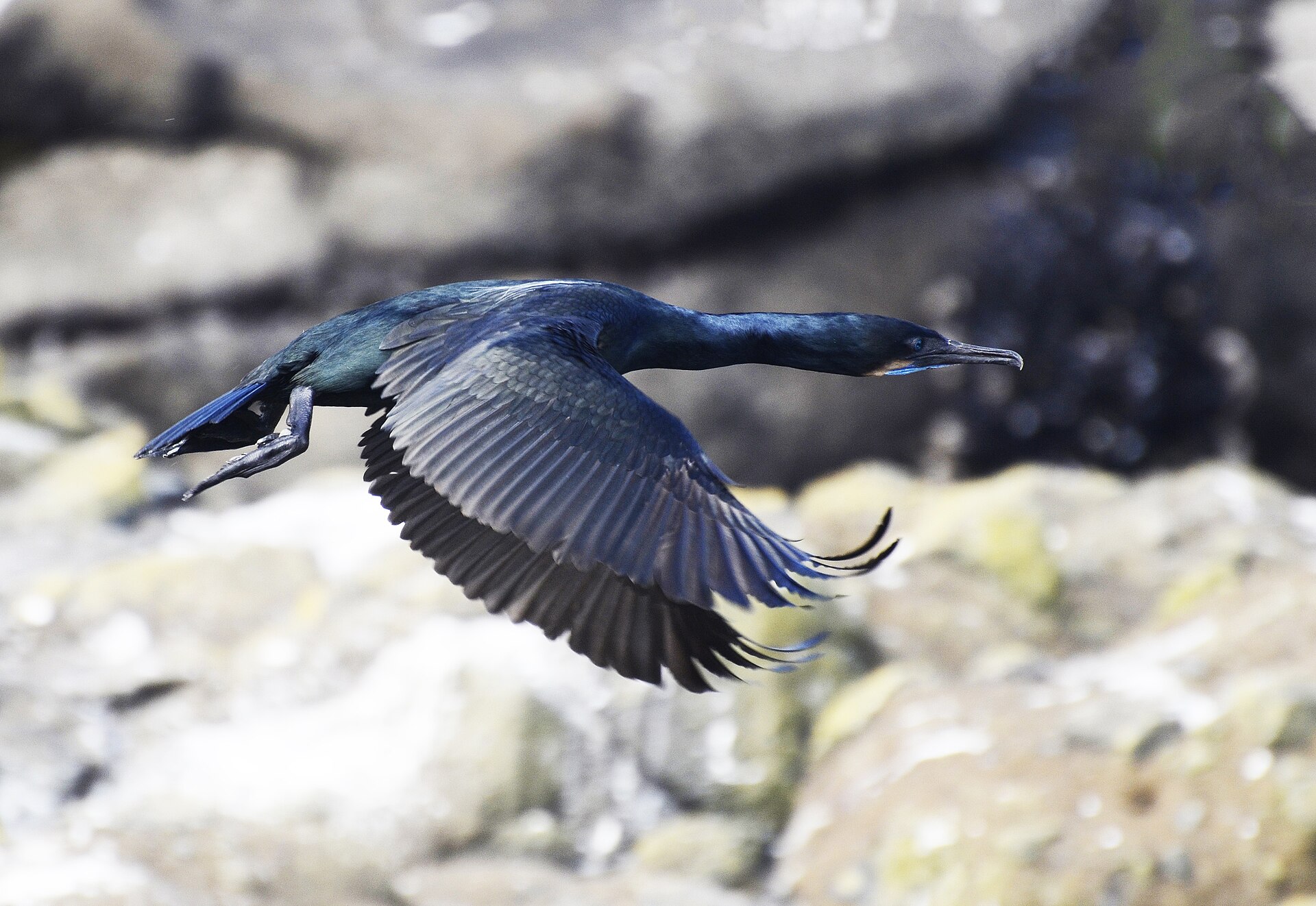
Brandt’s Cormorants are marine birds of the Pacific coast, closely tied to nearshore upwelling, rocky islands, and kelp-rich water. They seldom venture inland and are usually found within a few miles of land except during coastal movements.
Breeding adults are among the family’s most striking birds. Their black plumage takes on a blue-purple sheen, the eye turns intensely blue, and the throat becomes a vivid cobalt patch bordered with warm buff. Fine white plumes scatter across the head, neck, and shoulders.
Field identification
Blackish overall with a long hooked bill and rounded crown. Outside the breeding season, the throat patch becomes muted and brownish.
Vivid blue eye and gular pouch, buff border around the throat, and a loose veil of white filoplumes on the head and upper body.
Brown overall, with a paler neck and breast that can form a soft V. The long bill and strictly coastal setting help narrow the identification.
Habitat · food · nesting · behavior
Where it lives
Favors nearshore ocean, kelp beds, rocky headlands, islands, bays, and lagoons from British Columbia south to Baja California.
What it eats
Dives from the surface for schooling fish and squid, sometimes feeding near the seafloor. Flocks may join pelicans, gulls, auks, and sea lions over active prey.
How it nests
Males claim small territories on rocky islands, slopes, and cliffs. Pairs build bowl-shaped nests from grass, sticks, driftwood, and marine algae.
What to watch
Long neck held straight, broad wings working steadily, often just above the waves. Unlike many cormorants, it rarely spends long periods drying spread wings.
Globally listed as Least Concern, but its restricted marine range makes the species sensitive to food-web shifts, oil pollution, and disturbance at colonies. Long-term North American monitoring indicates meaningful declines in some regions.