Adult
Glossy black with a faint olive cast to the wings, a small orange throat patch, and a relatively short hooked bill.
Species profile
Nannopterum brasilianum
A slim, long-tailed cormorant of warm American waters—small enough for thin branches and adaptable enough for wetlands from Texas to Patagonia.
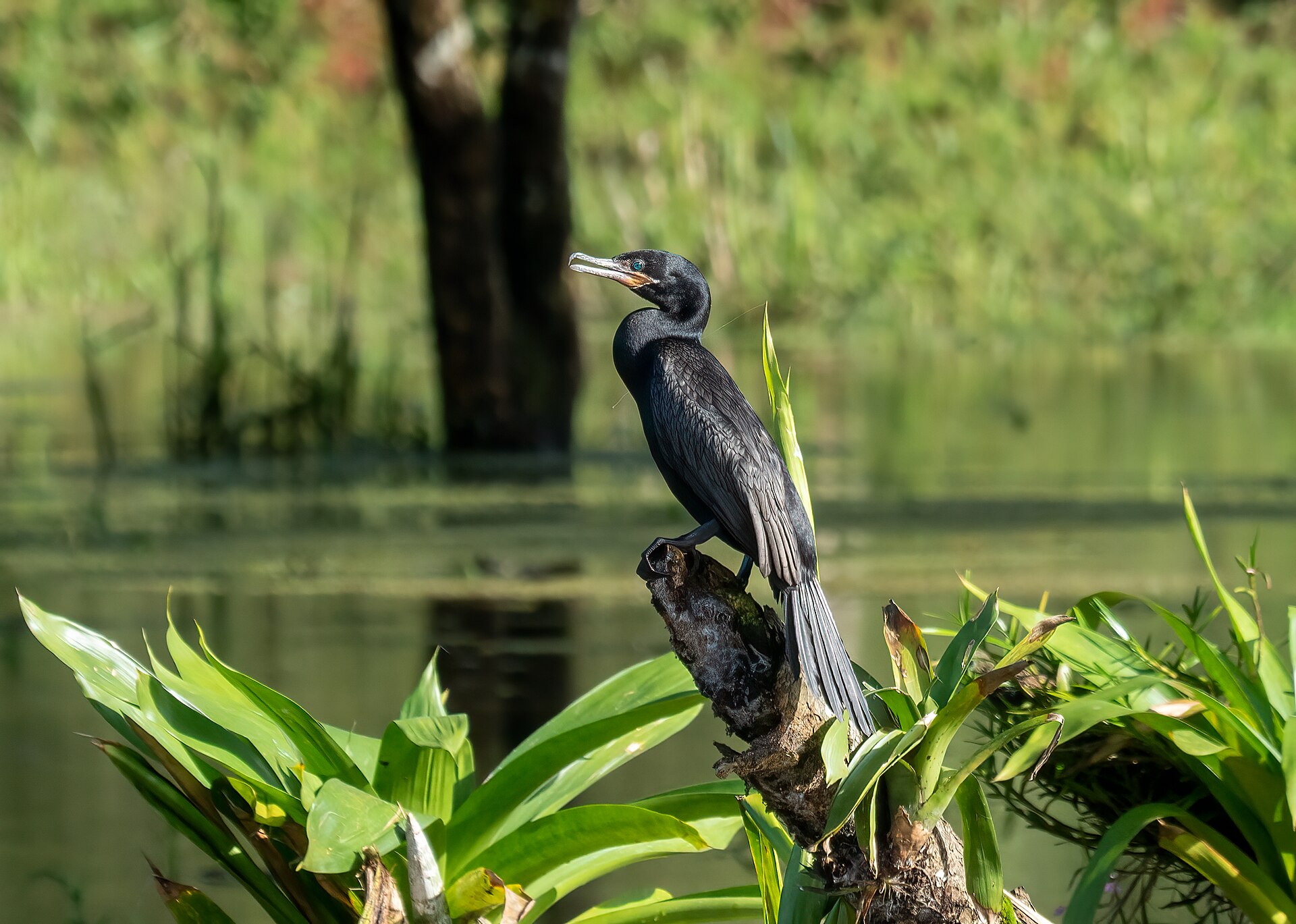
Neotropic Cormorants occupy an unusually broad mix of fresh, brackish, and saltwater wetlands. They fish in rivers, reservoirs, marshes, wooded swamps, fish farms, coastal lagoons, and sheltered bays, usually close to a place where they can rest.
Compared with the Double-crested Cormorant, this species looks narrow and elegant: a smaller head, shorter bill, slimmer neck, and a tail that projects conspicuously behind the body. It may even perch on wires or surprisingly delicate treetop branches.
Field identification
Glossy black with a faint olive cast to the wings, a small orange throat patch, and a relatively short hooked bill.
Thin white plumes appear on the head, while a narrow white line outlines the orange chin patch in a crisp V.
Paler brown on the head, neck, and breast. The small body, fine bill, and long tail remain the most useful structural clues.
Habitat · food · nesting · behavior
Where it lives
Uses lakes, rivers, ponds, marshes, swamps, reservoirs, inlets, estuaries, and coastal bays from the southern United States through much of Latin America.
What it eats
Usually pursues fish from the surface, but can also plunge into the water from a low flight. Shrimp, frogs, and aquatic insect larvae are also taken.
How it nests
The male selects a site, commonly in a small tree or tall shrub. Both partners assemble a loose platform of sticks and share incubation and chick care.
What to watch
Often fishes alone or in small groups, but may cooperate by beating the water and driving fish into shallows. It dries its wings from exposed perches.
Widespread and considered of low conservation concern. The species has expanded northward in the United States after twentieth-century declines, but nesting colonies remain vulnerable to disturbance and persecution around aquaculture.